Paul Ivanovitch Chichikov
Dead SoulsPaul Ivanovitch Chichikov is a well-mannered, socially agile traveller whose inconspicuous arrival in the provincial town of N. conceals a scheme to acquire dead peasants still listed as alive in the census. His measured self-presentation earns him the welcome of the town’s officials, while his proposed purchase exposes the legal and moral absurdity on which his enterprise depends. In these opening episodes, he is at once a calculated operator and the instrument through which ordinary provincial respectability is made strange.
Identity and Arrival
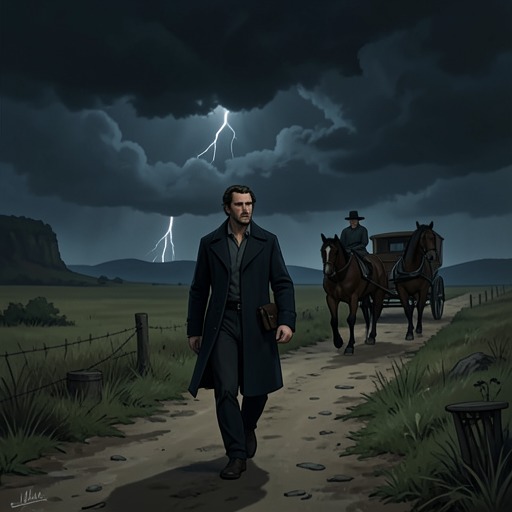
Chichikov arrives in a smart light carriage, the kind associated with gentlemen of an intermediate rank. The narrator’s description resists a striking portrait: he is neither handsome nor ill-favoured, neither particularly fat nor thin, and neither old nor young. The townspeople’s first attention falls on the carriage rather than its passenger. Two peasants speculate whether it might travel as far as Moscow, then dismiss the possibility of Kazan; their brief exchange registers the newcomer as an ordinary passing presence, not yet a person of consequence.
At the inn, the brisk waiter escorts Chichikov to a conventional provincial room, part of an establishment whose shabby familiarity makes it seem interchangeable with inns elsewhere. After dinner, coffee, and a long sleep, Chichikov gives his name and official rank for the police register: Collegiate Councillor, landowner, travelling on private affairs. The formula joins public standing to studied vagueness. It identifies him precisely enough to satisfy the law, but gives the town no account of what his private business actually is.
His inspection of N. takes in yellow stone buildings and grey wooden ones, unfinished walls, crowded shops, and signs advertising the supposed best establishment of every kind. Tables in the street offer nuts, soap, and gingerbread, the last scarcely distinguishable from the soap; the paving is uniformly bad. The comic inventory establishes a town of modest pretensions and familiar disorder. Chichikov’s own unremarkable arrival and later success belong to the same social landscape: appearances, labels, and claims to standing matter even where the substance beneath them is uncertain.
Winning the Town’s Confidence
The next day Chichikov begins an extensive round of official calls. He visits the Governor, the Vice-Governor, the Public Prosecutor, the President of the Local Council, the Chief of Police, the Commissioner of Taxes, and the Director of State Factories, then makes a point of seeing the Inspector of the Municipal Department of Medicine and the City Architect as well. The breadth of the circuit suggests deliberate social attentiveness: he leaves no prominent officeholder unattended.
His skill lies not in saying anything remarkable, but in giving each host the compliment best suited to the occasion. He praises the Governor’s province by describing its roads as velvety and credits the Governor with appointing capable subordinates. To the Chief of Police he offers praise of the local gendarmery. He twice addresses lesser-ranking officials as Your Excellency, a breach of rank that pleases rather than offends them. His mistakes, like his compliments, are calibrated to make others feel important.
For more than two weeks, invitations to dinners and evening parties keep him at the centre of the town’s social round. His manners seem perfectly measured; he neither raises nor lowers his voice beyond what the moment allows. The officials interpret this polished composure according to their own needs and expectations: the Governor sees good intentions, the Public Prosecutor business ability, the Chief of Gendarmery education, and the President of the Local Council breeding and refinement. Even the usually censorious Sobakevitch calls him a pleasant fellow after meeting him at the Governor’s. The accumulation of endorsements establishes how completely Chichikov has made social approval serve as cover.
The Purchase of the Dead Peasants
After these urban visits, Chichikov turns toward landowners beyond the town, including Manilov and Sobakevitch. The narration notes that his stated reason is a promise to visit, but signals that a more serious purpose lies closer to his heart. That delay makes the excursion the first visible movement toward a plan the town has not yet learned to imagine.
At Manilov’s estate, Chichikov asks for the list of peasants and proposes to purchase some of them. When Manilov asks how the transfer is to work, Chichikov first clarifies that he wants the peasants without land, then makes the startling point explicit: he wants dead ones. He specifies that these are people recorded as living in Manilov’s last census, although they have since died. The transaction depends on the gap between a person’s actual death and the continuing legal force of an unrevised register.
Manilov drops his pipe and stares, uncertain whether Chichikov is joking or has lost his wits. Chichikov’s face remains serious, and Manilov can find no sign of a joke. The scene’s stillness sharpens the absurdity: the proposal is so strange that Manilov’s first response is not negotiation but an attempt to determine whether his guest is sane. Chichikov, by contrast, treats the impossible-sounding business as a practical matter.
He reassures Manilov by insisting that the peasants should be written down as living, because that is how they appear in the census returns. He presents himself as scrupulously obedient to civil law, declaring that an obligation is sacred and that he does not step outside the law. This appeal settles Manilov somewhat without making the scheme intelligible to him. Chichikov’s verbal distinction between what the register says and what has happened to the peasants allows him to frame a morally disquieting purchase as a formally proper transfer.
Character and Narrative Function
Chichikov’s entrance and first dealings establish a sharp contrast between social performance and concealed purpose. In town, his restraint and readiness to flatter make him appear dependable; at Manilov’s, those same controlled manners accompany a request that unsettles the ordinary meaning of purchase and ownership. His success depends on fitting himself to the expectations of those he visits, while his plan exploits a system that continues to count the dead as taxable, transferable lives.
The novel initially presents him through other people’s impressions and through the outward signs he supplies: his carriage, his rank, his calls, his manners, and his carefully limited account of travelling on private affairs. Those signs generate confidence before anyone understands the project behind them. The impending revelation of his scheme promises to turn the town’s praise into perplexity, making Chichikov’s polished respectability not a reliable measure of character but the mechanism that enables his entrance into provincial society.